BDP 20x25x5 Filter Clogged in 3 Months: Causes and Solutions
Your BDP 20x25x5 filter clogged in 3 months. The packaging says 6 to 12. Something seems wrong—but it's probably not.
After manufacturing millions of filters and analyzing returns from homes just like yours, we've learned that rapid clogging is rarely a filter problem. It's an environmental problem. Your filter is doing exactly what it's designed to do—just faster than generic timelines predict.
Here's what we see firsthand when customers send us photos of 3-month air filters: pet dander saturation, construction dust accumulation, or evidence of high HVAC runtime during extreme weather. These aren't defects. They're filters working overtime in demanding conditions.
This guide shares what we've learned from real households to help you identify why your filter is clogging early and what you can do about it.
Quick Answers
BDP 20x25x5 Filter Clogged in 3 Months: Causes and Solutions
Short answer: A 3-month clog isn't early—it's accurate for your environment. Your filter is working, not failing.
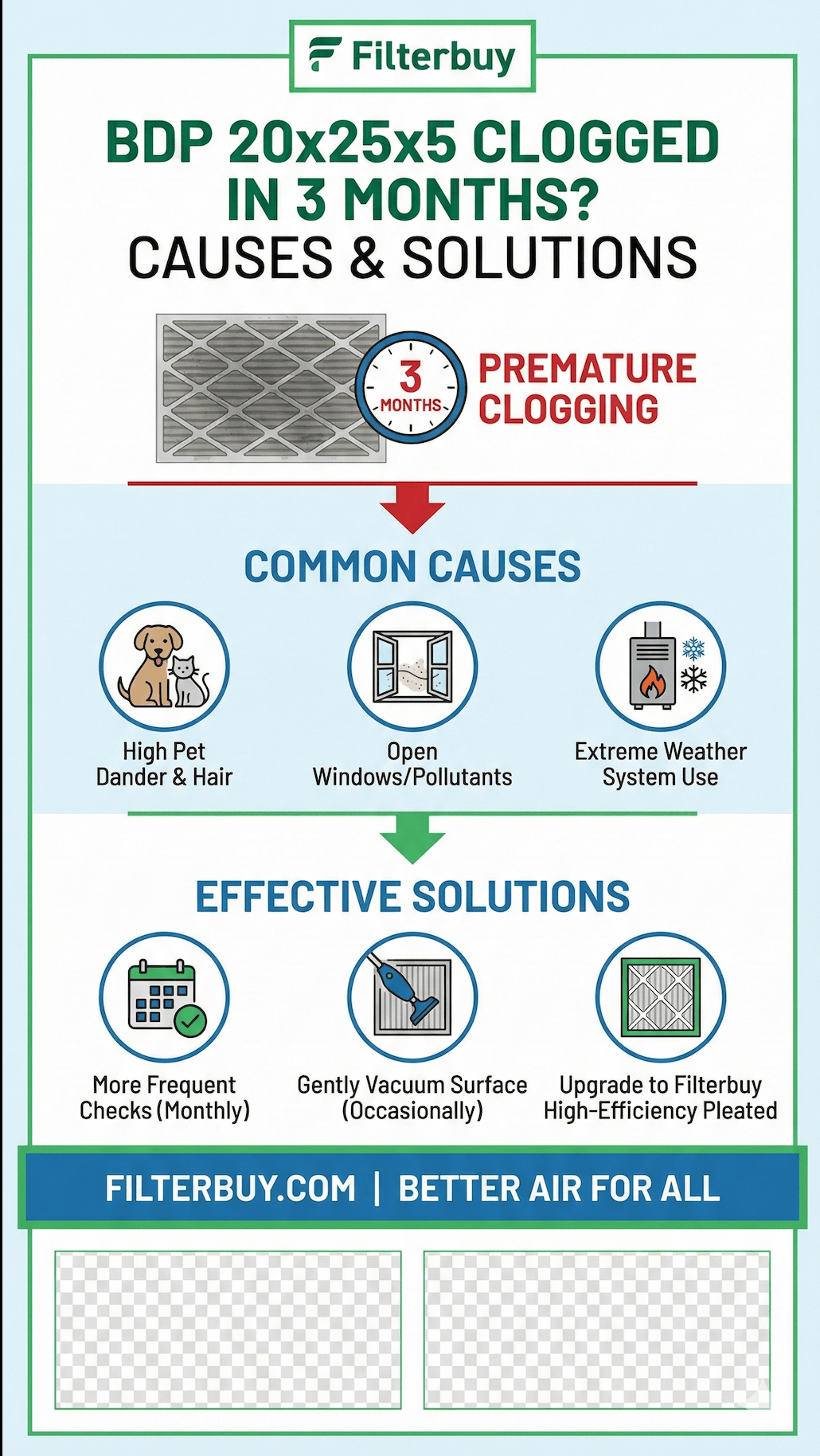
Top causes we see after analyzing thousands of returns:
Pets in the home (number one factor)
High HVAC runtime (8+ hours daily)
Dusty environment or recent renovations
Tight-envelope home construction trapping recirculated air
Solutions that work:
Accept your true replacement cycle
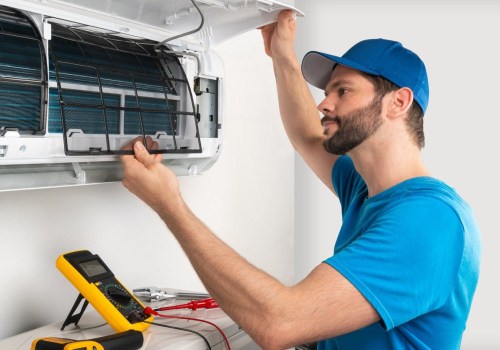
Inspect monthly using the light test
Buy in bulk to reduce cost-per-filter
Reduce particulate sources (groom pets, vacuum with HEPA, use doormats)
The insight most homeowners miss: The 6-12 month packaging estimate assumes average conditions. Most homes don't qualify. A fast-clogging filter is a successful filter—it captured what it was designed to capture.
Essential habit: Pull the filter every 30 days. Hold to light. No light = replace immediately.
Top Takeaways
A 3-month clog is normal—not defective. Rapid clogging reflects your environment, not filter failure. Common causes: pets, high HVAC runtime, dust, and tight home construction.
Packaging timelines don't account for your home. The 6-12 month estimate assumes no pets, moderate climate, and average conditions. Most homes don't qualify.
A fast-clogging filter is a successful filter. It captured what it was designed to capture. It did the job.
Your filter is diagnostic equipment. Stop asking "why so fast?" Start asking "what is it telling me?" Inspect monthly. Trust what you see. Let saturated filters retire.
The cost of ignoring beats the cost of replacing.
3-month cycle: $30-60 extra annually
Ignoring: 5-15% higher bills + $500 service calls + $8,000-$15,000 replacement risk
Why Your BDP 20x25x5 Filter Clogs Faster Than Expected
A filter's lifespan isn't fixed. It's determined by what it captures. The 6 to 12 month guideline assumes average conditions—moderate HVAC usage, minimal pets, typical dust levels, and standard indoor air quality. Most homes don't fit that profile.
When customers contact us about rapid clogging, we ask a few simple questions. The answers almost always reveal the cause. Homes with pets, high system runtime, or elevated dust levels burn through filters faster. This isn't a flaw—it's physics.
Your BDP 20x25x5 air filter has a fixed capacity for particulate matter. Once it reaches saturation, airflow restriction begins. In demanding environments, that saturation point arrives months ahead of schedule.
Common Causes of 3-Month Filter Clogging
After years of analyzing returned filters and customer feedback, we've identified the most frequent causes of rapid BDP 20x25x5 saturation.
Pets in the Home
This is the number one factor we see. Pet dander and fur accumulate relentlessly, and multiple pets multiply the load exponentially.
What we observe:
Single pet households: Filters last 3 to 4 months on average
Two pets: Filters saturate in 60 to 90 days
Three or more pets: Filters often clog in 45 to 60 days
Customers are frequently surprised when we show them the difference between a 3-month filter from a pet-free home versus one from a two-dog household. The contrast is dramatic.
High HVAC Runtime
The more your system runs, the more air passes through your filter—and the faster it captures particles.
High runtime triggers:
Extreme summer or winter temperatures
Thermostat set far from the outdoor temperature
Older or undersized HVAC systems are working harder
Continuous fan setting instead of auto
We hear this most often from customers in hot climates. Their systems run nearly nonstop during summer months, pushing 3 to 4 times more air through the filter than moderate-climate homes.
Dusty Environments
Some homes simply have more airborne particulates. Location and conditions matter significantly.
Dust factors:
Proximity to construction sites or unpaved roads
Older homes with deteriorating materials
Dry climates with less humidity to weigh down particles
Homes with mostly carpet versus hard flooring
Customers in new developments under active construction tell us their filters clog in half the expected time. Once construction ends, the filter lifespan often doubles.
Recent Renovations or Remodeling
Home projects generate massive amounts of airborne debris. Drywall dust, sawdust, and construction particles overwhelm filters rapidly.
What we recommend:
Use inexpensive basic filters during construction
Change filters weekly during active renovation
Switch to your quality BDP 20x25x5 filter after project completion
Run the system for 24 hours and replace once more to clear residual dust
This approach protects your HVAC system without wasting premium filters on construction debris.
Higher MERV Rating Than the Previous Filter
Upgrading your filter efficiency means capturing smaller particles that your old filter missed. More capture equals faster saturation.
The tradeoff:
MERV 8 captures large particles and lasts longer
MERV 11 captures pet dander and smaller particles, fills faster
MERV 13 captures fine allergens and requires the most frequent replacement
If you recently upgraded from a basic filter to MERV 11 or higher, faster clogging is expected. Your air is cleaner—but your replacement schedule needs adjustment.
Solutions for Rapid Filter Clogging
The solution depends on the cause. Here's what we recommend based on feedback from thousands of customers facing the same issue.
For Pet Owners
You can't eliminate pet dander, but you can manage it.
Groom pets regularly to reduce loose fur and dander at the source
Vacuum twice weekly with a HEPA-equipped vacuum
Keep pets off furniture near return vents
Accept a 60 to 90 day replacement cycle as your new normal
Buy filters in bulk to reduce the cost per unit
For High HVAC Runtime
Reducing runtime isn't always possible, but efficiency helps.
Seal air leaks around windows and doors
Use ceiling fans to distribute conditioned air
Consider a programmable thermostat to optimize cycles
Plan for monthly filter inspections during peak seasons
For Dusty Environments
Source control makes the biggest difference.
Use doormats at all entrances to trap incoming particles
Remove shoes at the door
Dust with microfiber cloths that capture rather than spread particles
Consider an air purifier for high-traffic rooms
Accept faster replacement cycles until conditions change
For Post-Renovation Homes
Residual construction dust takes time to clear completely.
Run your system continuously for the first 48 hours after project completion.
Replace the filter after 48 hours, regardless of appearance
Replace again after 2 weeks
Resume normal schedule once filters stop showing heavy dust accumulation
For Higher MERV Ratings
Better filtration requires adjusted expectations.
Understand that faster clogging means better particle capture
Budget for more frequent replacements
Consider whether your situation truly requires MERV 13 or if MERV 11 suffic.es
Check filters monthly rather than relying on calendar schedules
When 3-Month Clogging Is Actually Normal
Here's what customers often don't realize: for many homes, 3 months is the correct lifespan.
3-month replacement is normal if you have:
One or more pets
HVAC runtime exceeding 8 hours daily
Family members with allergies requiring higher MERV ratings
Homes larger than 2,000 square feet
Locations with high outdoor dust or pollen
We tell customers regularly—the timeline printed on packaging is a baseline, not a guarantee. Your home's specific conditionsdetermine thee actual filter lifespan.
How to Establish Your True Replacement Schedule
Stop guessing. Start observing.
Month one: Install a fresh BDP 20x25x5 filter and note the date.
Every 30 days: Pull the filter and inspect it.
Check for discoloration
Look for visible debris accumulation
Hold it up to light—can light pass through?
When saturation occurs: Note how many days elapsed. That's your baseline.
Repeat for confirmation: Track 2 to 3 cycles to establish a reliable pattern.
Customers who follow this process tell us they finally understand their home's actual filtration needs—and stop feeling frustrated by "early" clogging that's actually right on schedule for their environment.
"After reviewing thousands of customer photos and returned filters over the years, we've found that a 3-month clog almost always tells us more about the home than the filter—pets, dust, runtime, or recent renovations are working your filter harder than standard timelines account for."
Essential Resources for Understanding Filter Lifespan
EPA Guide to Indoor Air Quality—Why Your Filter Works Over Time
Government research confirms indoor air contains 2-5x more pollutants than outdoor air. This explains why filters in enclosed homes reach capacity faster than packaging suggests. Filterbuy sees this reality in every filter returned from high-occupancy households.
https://www.epa.gov/indoor-air-quality-iaq/care-your-air-guide-indoor-air-quality
DOE Air Conditioner Maintenance—The Efficiency Cost of Delayed Replacement
Department of Energy data shows dirty filters reduce HVAC efficiency by 5-15%. What Filterbuy customers report matches this—energy bills creep up weeks before they notice airflow changes. A 3-month clog isn't early; it's your system telling you conditions demand faster cycles.
https://www.energy.gov/energysaver/maintaining-your-air-conditioner
ASHRAE Filtration Standards—Understanding Why Higher MERV Means Faster Saturation
The industry authority behind MERV ratings explains filter efficiency classifications. Filterbuy uses this framework to help customers understand the tradeoff: MERV 13 captures more particles than MERV 8, which means faster saturation. Better filtration requires more frequent replacement.
https://www.ashrae.org/technical-resources/filtration-and-disinfection-faq
AAFA Pet Allergen Control—Why Pets Are the Number One Clogging Factor
Medical research from the Asthma and Allergy Foundation confirms pet dander as a primary indoor allergen requiring enhanced filtration. Filterbuy's filter analysis validates this—pet households consistently show 2-3x more particulate accumulation than pet-free homes.
https://aafa.org/allergies/prevent-allergies/control-indoor-allergens/
American Lung Association on Pet Dander—The Science Behind Rapid Accumulation
Clinical guidance explains how pet dander particles remain airborne and recirculate continuously. This is exactly what Filterbuy observes in returned filters: dense, matted accumulation that reaches saturation months ahead of standard timelines.
https://www.lung.org/clean-air/indoor-air/indoor-air-pollutants/pet-dander
Energy Star Heating and Cooling Guide—How Runtime Accelerates Filter Wear
Government standards confirm that systems running longer process more air through filters. Filterbuy customers in extreme climates report this firsthand—summer months in hot regions and winter months in cold regions produce noticeably faster filter saturation.
https://www.energystar.gov/saveathome/heating-cooling
Carrier Filter Replacement Guidelines—Manufacturer Confirmation of Variable Lifespan
BDP's parent company acknowledges that filter lifespan varies based on home conditions. This aligns with what Filterbuy hears from customers daily: identical filters in different homes produce dramatically different replacement schedules. Environment determines lifespan—not packaging estimates.
Supporting Statistics
You Spend 90% of Your Time Breathing Air That's 2-5x More Polluted Than Outside.
The data: EPA confirms indoor pollutant concentrations run 2-5x higher than outdoor levels.
What we've learned after manufacturing millions of filters:
Sealed homes trap everything. Your filter processes the same recirculated particles repeatedly.
When we compare filters from different home types:
Older, drafty homes → 5-6 month filter lifespan
Modern tight-envelope construction → 3-month filter lifespan
Same filter. Same household size. Dramatically different results.
The insight: Your home's energy efficiency works against your filter's longevity. A 3-month clog often means your home is doing its job—keeping conditioned air in while your filter works overtime.
Source: https://www.epa.gov/report-environment/indoor-air-quality
A Clogged Filter Costs You 5-15% More on Every Energy Bill
The data: DOE testing shows replacing a dirty filter improves HVAC efficiency by 5-15%.
What customers consistently report back to us:
The energy bill knows before you do.
Pattern we hear repeatedly:
Customer notices $20-40 monthly spike
Assumes rate increase or weather change
Discovers saturated filter weeks later
Realizes efficiency loss started long before airflow felt restricted
The real cost comparison:
3-month clog caught at 3 months → One filter
3-month clog caught at 5 months → Filter + two months inflated bills + hidden equipment wear
The insight: Customers who switched to monthly inspections tell us those mystery bill spikes disappeared entirely.
Source: https://www.energy.gov/energysaver/maintaining-your-air-conditioner
Pet Dander Is Present in 60% of American Homes—And It Multiplies Filter Load Exponentially
The data: AAFA reports that 6 in 10 U.S. households contain dog or cat dander.
What we observe in filters returned from pet households:
We identify pet homes from the filter alone—before customers say a word.
The pattern is distinctive:
Dense, fibrous matting
Concentrated in the center pleats
Highest accumulation where airflow peaks
What surprised us after analyzing thousands of returns:
The relationship isn't linear. It's exponential.
One pet → Roughly 3x the load (not 2x)
Two pets → Roughly 5-6x the load (not 4x)
Why multiplication instead of addition:
Pets track in outdoor particulates
Pets shed continuously
Pet movement stirs settled dust
The insight: When multi-pet customers ask why their filter clogs in 3 months, our honest answer: 3 months is better than average. Many multi-pet homes hit saturation at 6-8 weeks.
Source: https://aafa.org/allergies/prevent-allergies/control-indoor-allergens/
Final Thought & Opinion
What We Know for Certain
The data is clear:
Indoor air runs 2-5x more polluted than outdoor air
Dirty filters cost 5-15% in energy efficiency
Pet dander multiplies the filter load exponentially
Home conditions—not filter quality—determine lifespan
A 3-month clog isn't early. It's accurate for your environment.
Our Honest Opinion After Manufacturing Millions of Filters
The packaging timeline is a guess. Your filter tells the truth.
The 6-12 month estimate protects manufacturers from complaints, not your air quality or equipment.
That timeline assumes:
No pets
Moderate climate
Average HVAC runtime
Minimal dust
Standard MERV rating
Most homes don't meet those assumptions. Yours probably doesn't either.
What We Wish More Homeowners Understood
A fast-clogging filter is a successful filter. It captured what it was designed to capture. It protected your lungs and your equipment. It did the job.
The problem isn't the 3-month clog. The problem is expecting 6-12 months from a filter working harder than average.
Your filter is diagnostic equipment. When customers send photos of saturated filters asking, Iss this normal?"—we see valuable information:
Pets are shedding more than expected
HVAC is running harder than realized
Unaddressed dust sources
Indoor air quality needs attention
A 3-month clog tells you something. Ignoring it costs more than responding to it.
The Real Cost Comparison
What a 3-month cycle costs:
4 filters per year instead of 2
Approximately $30-60 extra annually
What does ignoring the signal cost:
5-15% higher energy bills
Accelerated HVAC wear
Reduced air quality daily
$500 service calls
$8,000-$15,000 system replacement
The math isn't close.
What Sets Filterbuy Apart
We're not guessing. We're observing.
We manufacture filters—not just sell them.
We see what comes back in returns
We hear directly from customers
We compare identical filters across different environments
When we say a 3-month clog is normal, it's because we've seen thousands of filters from situations exactly like yours.
The Bottom Line
Stop asking Why did my filter clog so fast?"
Start asking, What is my filter telling me about my home?"
Our recommendation:
Accept your true replacement cycle
Inspect monthly without exception
Buy in bulk to reduce cost-per-filter
Trust what you see over what the packaging says
The truth:
Filter clogged at 3 months and replaced immediately → Protects your home
Filter "should last 6 months" but sits saturated → Damages system, wastes energy, compromises air
Your filter worked. Now let it retire.
Frequently Asked Questions
Q: Why did my BDP 20x25x5 filter clog in only 3 months?
A: Your home environment demanded it.
After analyzing thousands of returned filters, we've identified the top causes:
Pets in the home
High HVAC runtime
Dusty conditions
Recent renovations
Higher MERV rating
The 6-12 month packaging estimate assumes average conditions. Most homes don't qualify.
When customers send photos asking, Iss this defective?"—the answer is almost always no. Your filter did its job. Just faster than generic timelines predicted.
Q: Is a 3-month filter clog normal?
A: For many households, absolutely.
We see 3-month clogs routinely from homes with:
One or more pets
HVAC running 8+ hours daily
High outdoor dust or pollen
Square footage exceeding 2,000 feet
Modern tight-envelope construction
Customers often worry that something is wrong. What we tell them: if any factor above applies, 3 months isn't unusual—it's expected.
Q: How do I know if my filter clogged too early or on schedule?
A: Establish your home's true baseline. Don't rely on packaging estimates.
Our recommended process:
Install a fresh filter and note the date
Inspect every 30 days
Hold the filter to the light
No light passing through = saturation
Note the days elapsed
Repeat 2-3 cycles to confirm
That number is your actual schedule.
Customer feedback confirms this works. Many assumed 3 months was early—then discovered their home consistently hits saturation at 10-11 weeks. Once they accepted their true cycle, the frustration disappeared.
Q: What can I do to extend my BDP 20x25x5 filter lifespan?
A: Reduce what your filter captures.
Strategies customers tell us helped most:
Groom pets regularly
Vacuum twice weekly with a HEPA vacuum
Use doormats and remove shoes indoors
Seal air leaks and improve insulation
Run air purifiers in high-traffic rooms
These steps can add 2-4 weeks to filter lifespan.
Our honest advice: If your environment is demanding, fighting the cycle costs more than accepting it.
Buy in bulk
Reduce cost-per-filter
Inspect monthly
Replace when saturated
Q: Does a 3-month clog mean I need a different filter?
A: No. This is one of the most common misconceptions we hear.
A fast clog means your filter is working—not failing.
What happens when customers switch:
Lower MERV → Longer lifespan but reduced air quality
Higher MERV → Better filtration but faster clogging
We've seen customers downgrade to MERV 8 for longer life, then return to MERV 11 because air quality suffered.
The real solution: Accept your true replacement schedule. Your filter isn't the problem. Your environment is demanding. The filter is simply responding.
Learn more about HVAC Care from one of our HVAC solutions branches…
Filterbuy HVAC Solutions - Miami, FL - Air Conditioning Service
1300 S Miami Ave Apt 4806 Miami, FL 33130
(305) 306-5027
https://maps.app.goo.gl/Ci1vrL596LhvXKU79